For most of the last decade, "update the kitchen" quietly meant "paint everything white." That era isn't over, but it's no longer the only conversation happening in Atlanta kitchens, and the alternatives gaining ground say a lot about how homeowners want their kitchens to feel, not just look, in the years ahead.
Kitchen Cabinet Color Trends Atlanta Homeowners Are Choosing
Trends are a starting point for inspiration, not a mandate. The right color for your kitchen still depends on your countertops, flooring, natural light, and how long you plan to live with the result. This guide walks through what's popular right now and, just as importantly, how to translate a trend into a choice that will still look intentional in five years rather than dated in two, using real Atlanta kitchens as the reference point rather than a generic national trend forecast.
When you're ready to move from inspiration to execution, our cabinet painting service in Atlanta handles the preparation, coating, and durability side once a color direction is chosen.
Two-Tone Cabinets: Still Going Strong
Pairing a deeper color on the lower cabinets, often an island in particular, with lighter upper cabinets remains one of the most requested layouts we see. The approach grounds the kitchen visually, keeps upper cabinetry feeling open and airy, and gives homeowners a way to introduce a bolder color, navy, forest green, even black, without committing the entire room to it. Islands specifically have become almost a separate design decision from the surrounding cabinetry, frequently painted in a completely different color or even a contrasting stain to function as a piece of furniture within the kitchen.
A less common but growing variation flips the traditional ratio, using color on the uppers and a lighter tone on the lowers, which can make a small kitchen feel taller by keeping the visually heavier color above eye level rather than grounding it at the floor. This approach works best in kitchens with strong natural light, since a darker upper cabinet run in a dim room can feel closing rather than dramatic.
Warm Neutrals Are Replacing Stark White
Crisp, cool white dominated cabinet color for years, but warmer alternatives, soft creams, greiges, and putty tones, have steadily gained ground as homeowners look for a softer, less clinical feel. These warmer neutrals tend to photograph and live better under Atlanta's mix of natural light and warm-toned recessed lighting common in many homes, avoiding the slightly cold, sterile look a stark white can take on in certain light conditions. They also pair more forgivingly with warm wood floors and natural stone countertops that carry any hint of gold, tan, or brown undertone.
This shift doesn't mean white cabinets are disappearing, they remain a dependable, broadly appealing choice. It means the definition of "white kitchen" has quietly softened, with fewer homeowners requesting the coolest, most stark white on the fan deck and more requesting something with a whisper of warmth that still reads as a clean, neutral base.
Curious which trend actually fits your kitchen?
We can bring samples into your space and test them against your real countertops and lighting.
Request a Free Estimate Call 770-847-2468Dark, Moody Lowers Paired With Light Uppers
Charcoal, deep espresso brown, and near-black cabinet colors continue to show up, most often on lower cabinets and islands rather than an entire kitchen, since a fully dark kitchen can feel heavier than most homeowners want in a room used constantly throughout the day. Paired with lighter uppers, a light stone or quartz countertop, and adequate lighting, this combination reads as dramatic and current without sacrificing the practical brightness a kitchen needs for everyday cooking and cleanup.
Dark lowers also do practical work that lighter colors don't: they hide scuffs, fingerprints, and the general wear that accumulates at counter height where hands, dish towels, and appliances make constant contact. This is one case where a design trend and a genuinely practical maintenance benefit happen to line up well for a busy household kitchen.
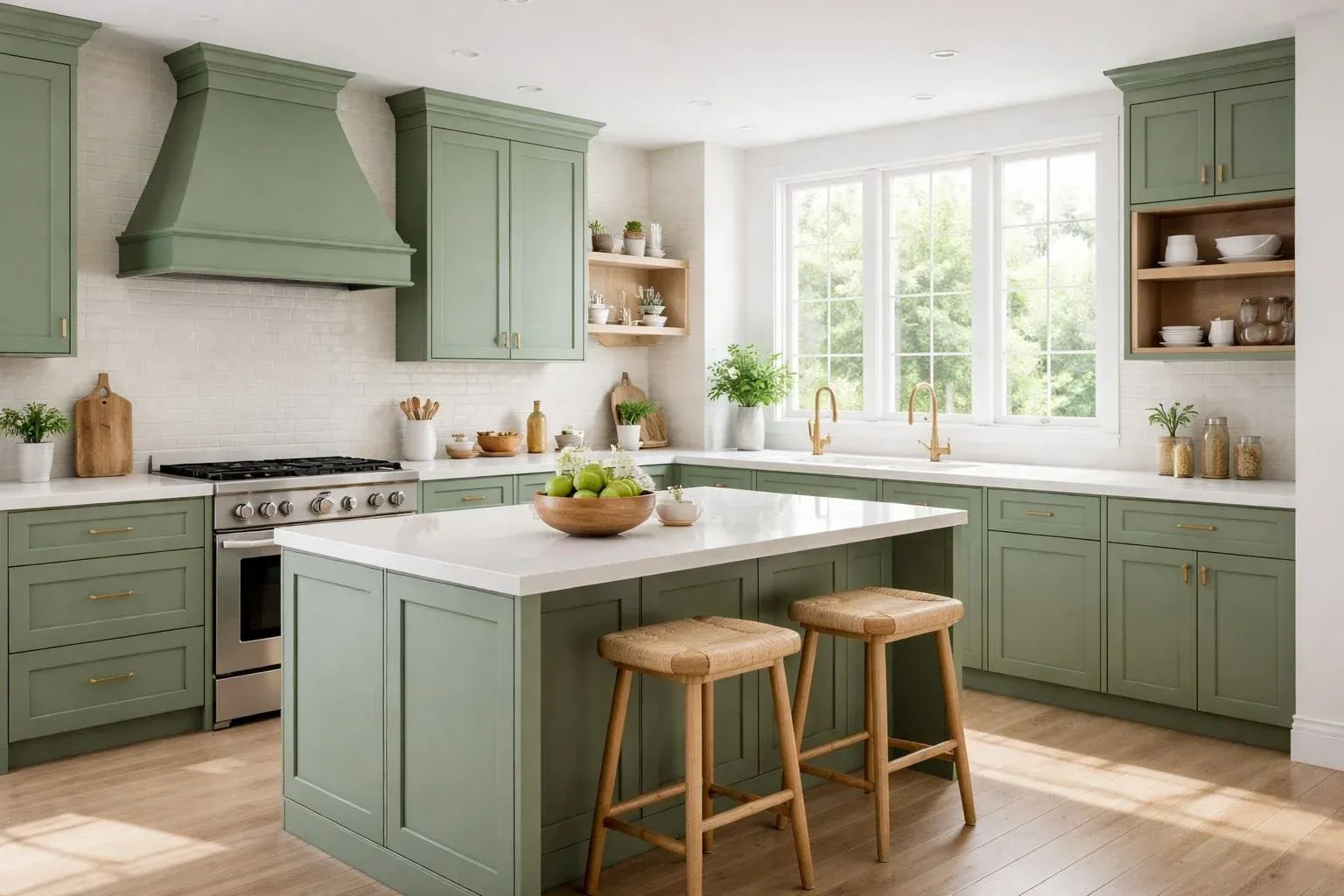
Sage, Olive, and Deep Green Continue to Grow
Green has moved from a niche accent choice to one of the most requested whole-kitchen cabinet colors we see, spanning a range from soft, muted sage to deeper olive and forest tones. Green's natural, earthy quality pairs comfortably with warm wood floors, brass and unlacquered hardware, and natural stone, which is likely a big part of its staying power compared to more fleeting color trends. Muted, grayed-down greens tend to feel more timeless than a bright, saturated green, which can read as more of a fashion statement with a shorter shelf life.
Green also works particularly well in kitchens with a view to a backyard or garden, extending the connection to the outdoors inward in a way few other cabinet colors can. Homeowners in wooded Atlanta neighborhoods with mature tree cover often gravitate toward green specifically for this reason, finding it feels more integrated with the surrounding landscape than a stark neutral would.
Navy and Slate Blue for a Timeless Alternative to Black
Navy and deeper slate blues offer much of the same dramatic contrast as black cabinetry while feeling slightly warmer and less severe in a kitchen setting. These colors pair especially well with brass, aged brass, and warm wood accents, and they photograph beautifully against white or light stone countertops. Because blue is generally perceived as calming and classic rather than trend-driven, it tends to have a longer runway before it starts to feel dated compared to some of the more fashion-forward colors on this list.
Slate and denim-toned blues, slightly grayer and less saturated than a true navy, have also picked up momentum as a softer alternative that reads as sophisticated without the formality a deep navy can bring to a casual, everyday kitchen. Either shade tends to pair more successfully with cooler-toned stone than with very warm wood, so it's worth confirming that relationship with a real sample before committing.
See These Colors on Real Cabinets First
We can show you sample doors in several of these trending colors before you commit to your whole kitchen.
Explore Cabinet PaintingMixing Painted Cabinets With Natural Wood Accents
Rather than painting every cabinet in the kitchen, many homeowners are pairing painted perimeter cabinetry with a natural wood island, open shelving, or a wood hood surround left unpainted. This mixed-material approach adds warmth and texture without committing the entire kitchen to a single finish, and it gives a kitchen a collected, evolved feel rather than looking like everything was selected from the same single showroom display all at once.
Open shelving in particular has settled into a more restrained role than its peak trend moment a few years ago, often appearing as a single accent section rather than a full wall of exposed storage. When paired with painted perimeter cabinetry, a short run of open wood shelving can break up a large expanse of a single color and give a spot to display a few curated items without turning the whole kitchen into a display case.
A wood range hood surround is another popular way to introduce this contrast without a large commitment. Left in a natural or lightly stained finish against painted surrounding cabinetry, it becomes a focal point above the range that draws the eye without requiring the rest of the kitchen to compete for attention, and it is a relatively small, contained element to install or refinish compared to reworking an entire wall of cabinetry.
Style Influences Across Metro Atlanta Kitchens
Kitchen color choices in Atlanta often reflect the architecture surrounding them. Craftsman bungalows in Decatur and Kirkwood tend to favor warmer, earthier colors, sage, olive, warm cream, that feel consistent with the home's original character and wood tones. Newer construction in Alpharetta, Johns Creek, and Milton frequently leans toward the dark-and-light two-tone combinations and navy or charcoal islands that photograph well against the clean, larger-format kitchens common in these builds. Traditional brick colonials in Marietta and Sandy Springs often split the difference, pairing a warm neutral perimeter with a single bolder island color as a middle ground between classic and current, reflecting the balance those homes strike architecturally as well.
None of this is a rule, only an observation of what tends to feel most cohesive with each style, and a color that breaks the pattern intentionally can look just as successful when it's a deliberate choice rather than an overlooked mismatch.
Hardware and Countertop Pairings That Complete the Look
Hardware finish has become as much a part of the "look" as the cabinet color itself. Warm brass and unlacquered brass, which develops a natural living patina over time, pair beautifully with greens, warm neutrals, and navy. Matte black remains a versatile, budget-friendly option that works with nearly every color on this list. Countertops with some movement and warmth, quartzite, marble, or a veined quartz, tend to complement painted cabinets more successfully than a stark, uniform white counter, which can make a colored cabinet feel disconnected rather than intentional.
Mixed metals, pairing brass hardware with a stainless or matte black faucet and fixtures, have become common enough that they no longer read as a mistake the way strict single-metal rules once suggested. The more reliable guideline now is repetition rather than uniformity: repeat each metal finish at least twice somewhere in the room so it reads as a deliberate layer rather than a single mismatched piece.

Trend vs. Timeless: What to Consider for Resale
If you plan to sell within the next few years, lean toward colors with broad appeal, warm neutrals, muted greens, and classic navy tend to perform well because they read as intentional and updated without alienating buyers who prefer a more neutral kitchen. Highly saturated, unusual, or extremely dark whole-kitchen colors can narrow buyer appeal, though a bold island or accent color within an otherwise neutral kitchen is a lower-risk way to introduce personality. If resale isn't a near-term concern, this calculation matters far less, and choosing a color you'll genuinely enjoy living with should take priority.
A useful middle path for homeowners who aren't sure how long they'll stay is to keep the perimeter cabinets in a safe, timeless neutral and reserve a trend-forward color for the island alone. This limits the cost and effort of a future repaint to a single, smaller piece of cabinetry if tastes change or the home eventually goes on the market, rather than requiring a full-kitchen redo.
Testing Cabinet Colors Before Committing
Paint a large sample on a spare door, an interior cabinet end panel, or a poster board propped against your actual cabinets, and view it throughout the day under your kitchen's real lighting. Hold the sample next to your countertop, backsplash, and flooring rather than judging it in isolation, since undertones that look fine alone can clash once placed beside your home's actual materials. Our broader guide to interior paint colors in Atlanta covers testing methodology and undertone matching in more depth, including how Atlanta's specific light conditions shift a color throughout the day.
Why Execution Matters as Much as the Color Itself
Even the most on-trend color will look unconvincing on cabinets that weren't properly degreased, sanded, primed, and finished with a durable cabinet-grade topcoat. Kitchen cabinets face constant handling, moisture, and cleaning that ordinary wall paint was never designed to withstand, which is why the technical execution behind a cabinet repaint matters as much as the color decision itself. Our dedicated guide to cabinet paint finish in Atlanta covers the preparation and coating system in full detail.
A trend chosen in isolation from execution quality is where cabinet projects most often disappoint. The same sage green can look furniture-grade and intentional in one kitchen and slightly amateurish in another, and the difference almost always comes down to preparation, coating choice, and application quality rather than the color itself being right or wrong.
Get the Color and the Finish Right Together
Color inspiration means little without the preparation and coating system to back it up long-term.
Request a Free EstimateBudgeting a Cabinet Color Refresh
Painting existing cabinets is almost always significantly less expensive than replacing them, since it preserves the existing boxes, layout, and often the countertops and backsplash as well. The main cost drivers are the number of doors and drawer fronts, the condition of the existing finish, whether hardware locations are changing, and the coating system chosen. For a larger, whole-kitchen color change combined with other updates, our financing options can help spread the cost of a full project rather than requiring everything paid upfront, especially when it's bundled with adjacent rooms.
Getting a written, itemized estimate that separates degreasing and prep, priming, topcoat, and hardware handling helps you understand exactly what is driving the total price, and makes it easier to compare against any other quotes you gather before deciding on a final direction.

Common Mistakes When Chasing a Cabinet Color Trend
Following kitchen cabinet color trends from a photo without testing in your kitchen
Lighting, countertop material, and floor tone all shift how a color actually reads once it's on your specific cabinets, which is why a color that photographs beautifully online can still disappoint in person.
Ignoring hardware and countertop compatibility
A beautiful cabinet color can look disjointed if the surrounding hardware and countertop weren't considered together.
Committing the whole kitchen to a very trend-driven color
Using a bold, fast-moving trend color on an island or accent rather than every cabinet limits how quickly the kitchen can feel dated.
Skipping professional-grade preparation to save money
A trendy color applied without proper degreasing, sanding, and cabinet-rated topcoat will chip and wear far faster than the design deserves.
Overlooking the sheen and how it reads at scale
A sheen that looks fine on a small sample can appear noticeably shinier or flatter once applied across an entire kitchen's worth of doors and drawer fronts under real lighting.
Our Approach to Cabinet Color Projects
We help homeowners translate a color they love into a durable, professionally executed result, from sampling against your actual kitchen to the coating system underneath, so the finished cabinets look as good in three years as they do on day one. Review finished kitchens in our project gallery, learn more about our painting company, or confirm coverage on our service areas page.
Ready to bring your kitchen color vision to life?
We can sample colors in your kitchen and provide a free, no-obligation estimate for the full project.
Get Your Free EstimateFrequently Asked Questions
What is the most popular kitchen cabinet color right now?
Warm neutrals and soft greens are currently the most requested colors in Atlanta kitchens, gradually replacing the stark white that dominated cabinet color choices for the past decade.
Are two-tone kitchen cabinets still in style?
Yes. Pairing a deeper lower cabinet or island color with lighter upper cabinets remains one of the most requested layouts, offering visual grounding without committing the whole kitchen to a bold color.
Will a trendy cabinet color hurt my home's resale value?
A well-executed, tasteful color rarely hurts resale value on its own, but an extremely bold or personal color can narrow buyer appeal. Neutral bases with color used more selectively tend to balance personality with broad resale flexibility.
Should I paint or replace my cabinets to update the color?
If the cabinet boxes and doors are structurally sound, painting is typically far less expensive than replacement and can completely transform the kitchen's look using the existing layout and hardware locations.
How do I test a cabinet color before committing?
Paint a large sample on a spare door, the inside of a cabinet end panel, or a poster board, and view it against your actual countertop, backsplash, and flooring in the kitchen's real lighting throughout the day.
What sheen works best for a trendy cabinet color?
A durable satin or semi-gloss cabinet-grade finish is standard regardless of the color trend chosen, since kitchens see heavy daily handling that a decorative wall paint sheen is not built to withstand.

About Impeccable Painting Services
We help Metro Atlanta homeowners bring cabinet color inspiration to life with durable, professionally applied coating systems built for daily kitchen use.
Sources: Sherwin-Williams Color of the Year and trend reports; Benjamin Moore Color Trends.